
Overview
Watchman Tower alerts you when an incident opens on a monitor and again when it resolves. Alerts are configured per monitor and per person: everyone with access to a monitor has their own notification settings.Email and push are available on every plan. Slack and SMS are available on the Team and Stack plans.
Per-Monitor Notification Settings
Every monitor can have unique notification preferences: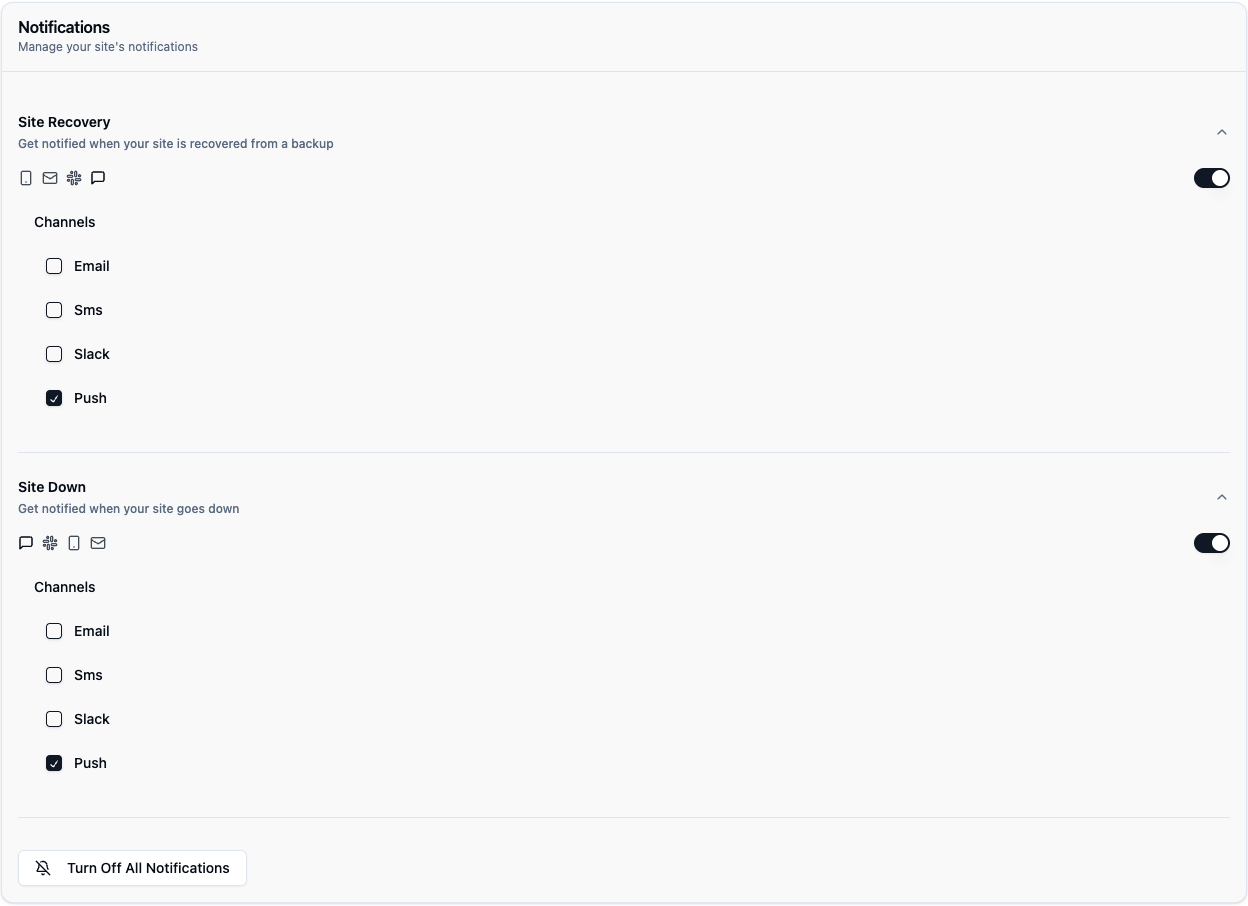
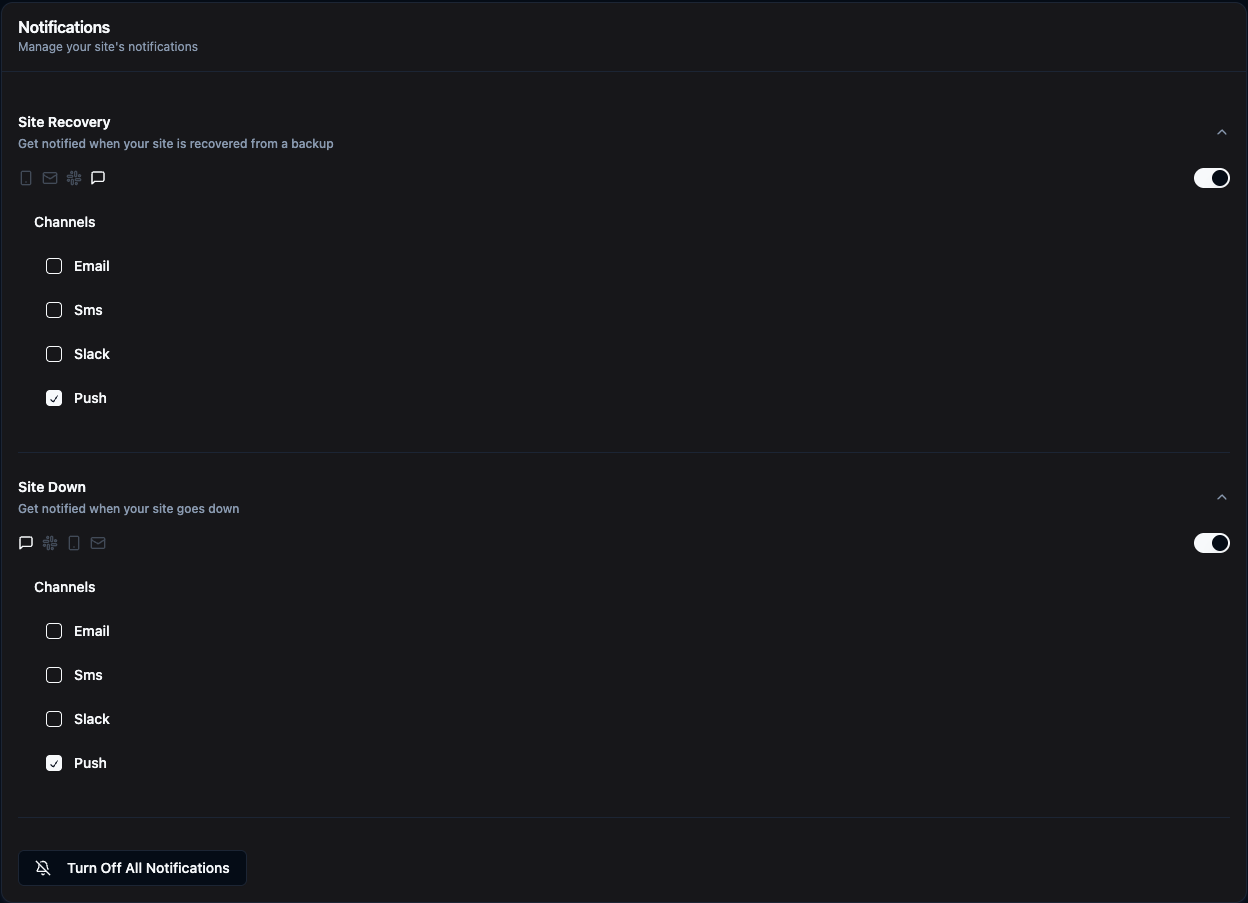
- Alert types - Turn each alert type (such as Availability or WordPress) on or off
- Channel selection - Choose which channels each alert type uses
- Slack channel - Pick the Slack channel for each alert type
Managing Notifications
Besides each monitor’s Notifications tab, the Notification Settings page lists the settings of all your monitors, with filters and bulk on/off controls: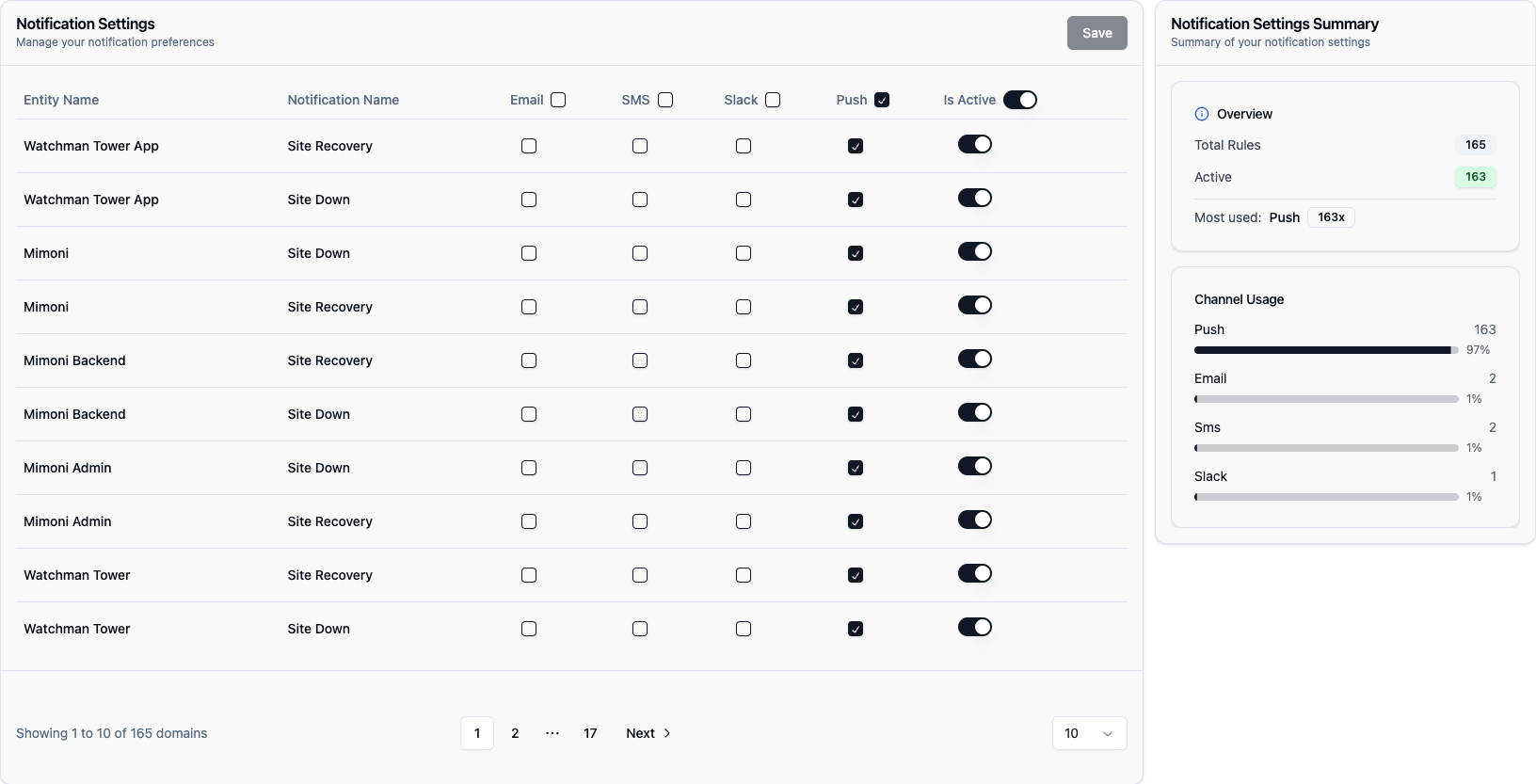
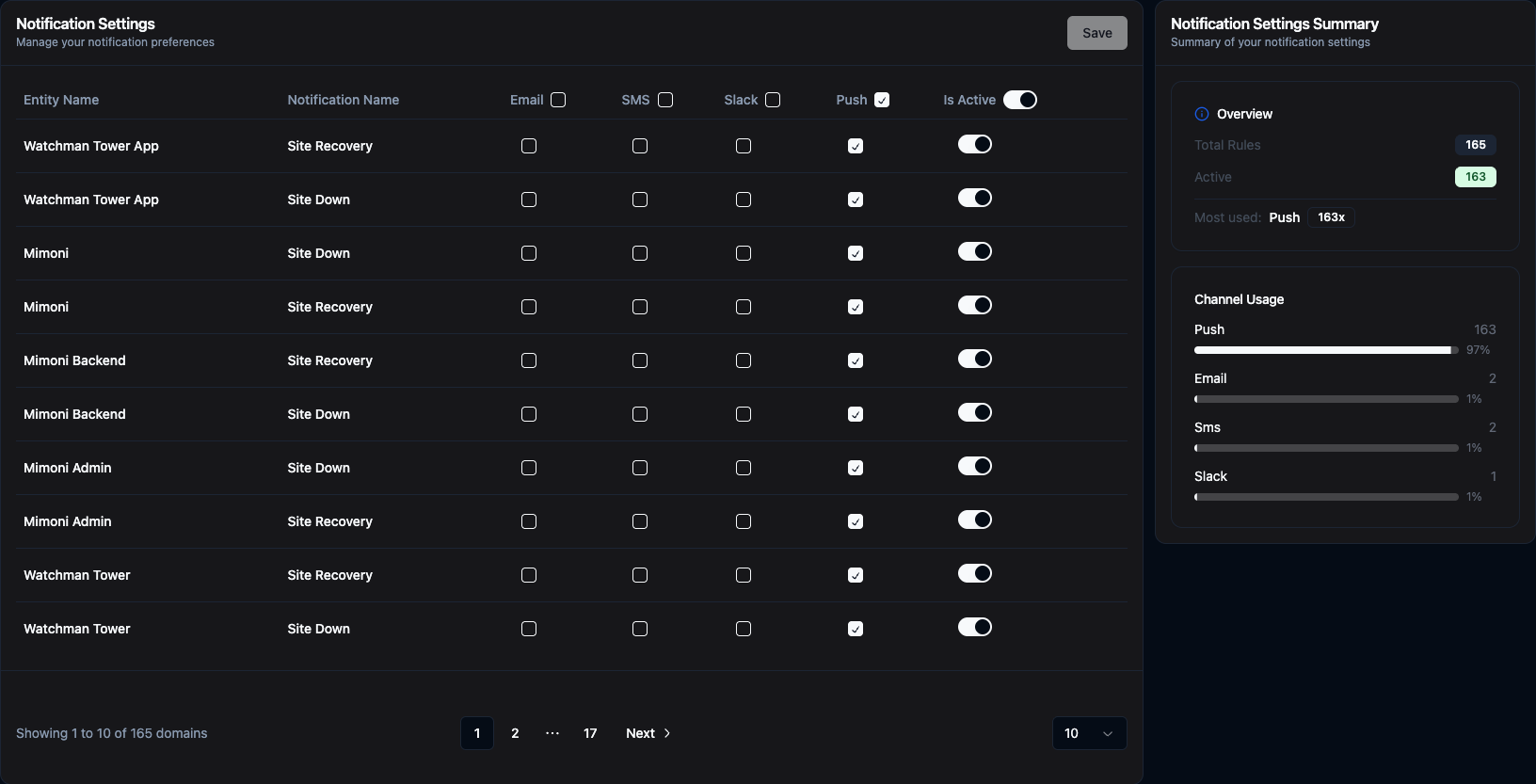
- Check notification settings for every monitor at a glance
- Filter by monitor or alert type
- Turn alert types and channels on or off in bulk
Available Notification Channels
Email Notifications
Detailed email alerts. All plans
Slack Integration
Alerts in a Slack channel you choose. Team and Stack
Push Notifications
Mobile app notifications. All plans
SMS Alerts
Text messages to your verified number. Team and Stack
Alert Types
Incident Alerts
An incident opens when checks confirm that a site is failing. Every site is checked from three regions (Frankfurt, New York, and Singapore). What opens an incident:- Connection failures and timeouts
- HTTP error responses (500, 502, 503, etc.)
- DNS resolution failures
- SSL/TLS errors
- An outage seen from all regions notifies immediately
- A failure seen from one region, or a partial one, must repeat across consecutive checks before an incident opens
- Lower-severity incidents wait 5 to 15 minutes before notifying; if the problem clears in that time, nothing is sent
- Severity and a plain-language summary of what is failing
- The primary cause
- A link to the monitoring page
Recovery Alerts
Sent when the incident resolves, on the same channels as the opening alert. Email, push, and Slack include how long the incident was open. A recovery alert is sent only if the opening alert was sent. If the site fails again within minutes of recovering, the same incident reopens and you receive one “reopened” alert.Frequent Short Outages
When a site has dropped briefly four or more times in seven days (each outage 15 minutes or less), short outages stop being alerted one by one. A new outage is alerted only if it lasts longer than 15 minutes. You are notified when this starts and when it ends.SSL Expiry Reminders
Sent by email and push 30, 14, 7, 3, and 1 day before the certificate expires, and on the day it expires.Domain Expiry Reminders
Sent by email and push 30, 14, 7, 3, and 1 day before the domain registration expires, and once after it expires.See Domain Monitoring for more on domain expiry tracking. Expiry reminders are sent on a fixed schedule and are not controlled by the per-monitor channel settings.
Server Alerts
For monitored servers, you define your own alerts: a metric (CPU, memory, disk, or network), a threshold, how long the value must hold, and a cooldown between alerts. Server alerts can use email, push, Slack, and SMS.Notification Preferences
Multiple Channels
You can enable multiple notification channels for redundancy: Example configuration:- ✅ Email - For detailed information and records
- ✅ Push - For instant mobile notifications
- ✅ Slack - For team awareness
- ☐ SMS - Reserved for critical production sites only
What Is Not Configurable
- Thresholds for website incidents (the confirmation rules above are fixed)
- Quiet hours, schedules, or maintenance windows
- Escalation chains or acknowledgement: all active channels are notified at the same time
- Extra recipients on a monitor: alerts go to each person with access, on their own channels
Notification Limits
Each plan has daily, weekly, and monthly notification limits across all channels. When a limit is reached, further notifications are not delivered until it resets, and the account owner is told by email. Critical availability incidents are exempt, up to five per site per channel per day. In-app notifications are always recorded.Best Practices
Start with essential alerts
Start with essential alerts
Begin with Availability alerts on Email and Push. Add more channels as needed to avoid notification overload.
Use SMS wisely
Use SMS wisely
SMS has the lowest daily limit of all channels. Reserve it for your most critical production monitors.
Verify your contact details
Verify your contact details
Email alerts need a verified email address and SMS needs a verified phone number. Without verification those channels send nothing.
Review regularly
Review regularly
Periodically review your notification settings and adjust based on what’s working.
Use bulk management
Use bulk management
As your monitoring footprint grows, review alert settings regularly so routing stays aligned with operational priorities.
Turn Off All Notifications
Need a break or performing maintenance? You can temporarily disable all notifications:- Go to Notification Settings
- Click “Turn Off All Notifications” button
- All alerts are paused until you turn them back on
Next Steps
Email Alerts
Configure email notifications
Slack Integration
Set up Slack notifications
Push Notifications
Get mobile app notifications
SMS Alerts
Set up text message alerts